#What Is a Photobot?
Photobots live in a world of pure energy. The energy field is made from an image you supply. Each Photobot has a body, sensors, actuators, energy reservoirs, urges, attention, memory-like consequence traces, maturation, mating, pregnancy, gestation, birth, waste, damage, and death, all expressed via its DNA.
Photobots provides a small embodied life model where colour, body, action, and ancestry are coupled tightly enough to produce surprising behaviour and interesting etchings on images.
#Colour is Energy; Energy is Food
The Photobots engine reads the image as a field of available colour energy. A bot can sense nearby colour, learn to move towards it, eat it, and then digest it.
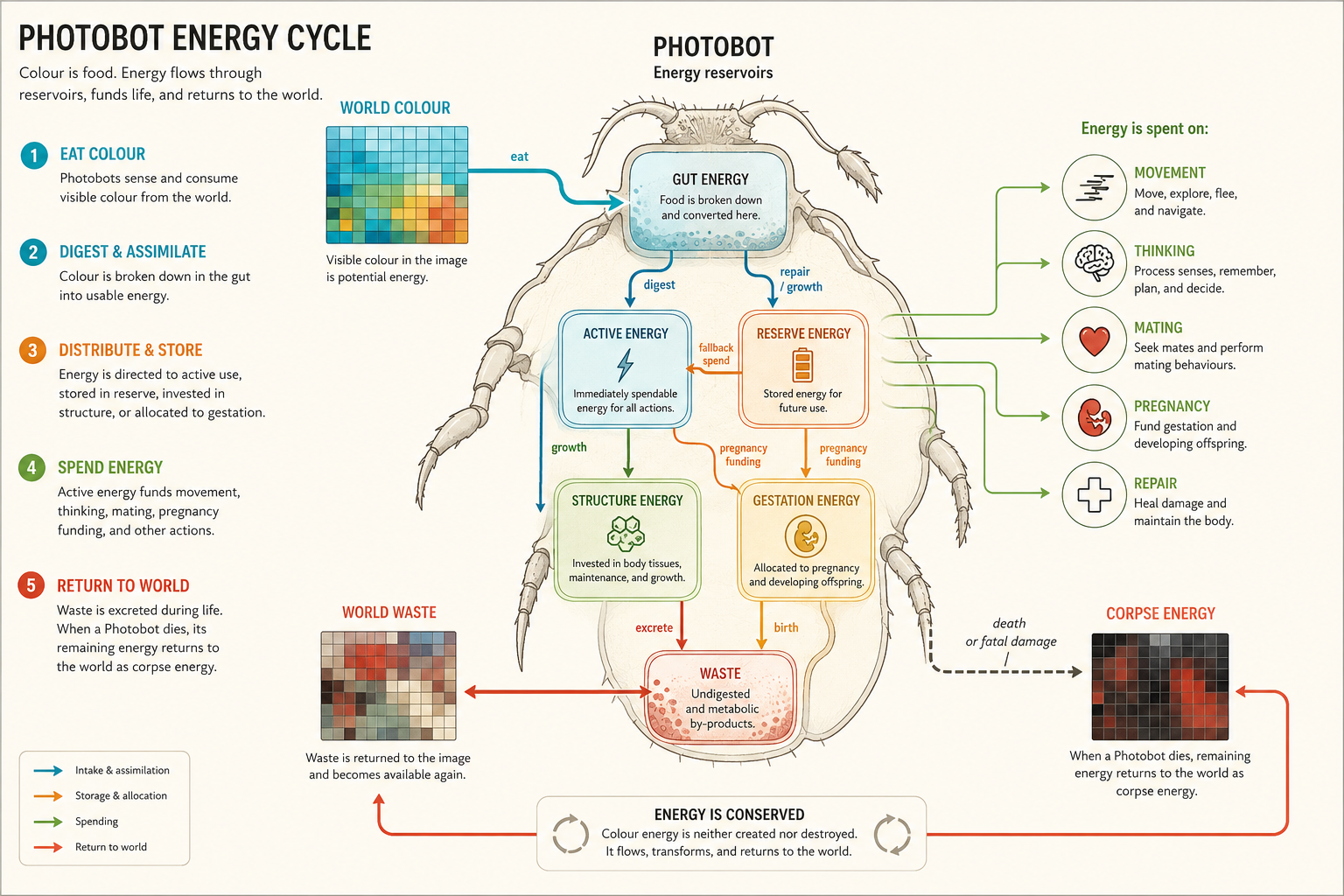
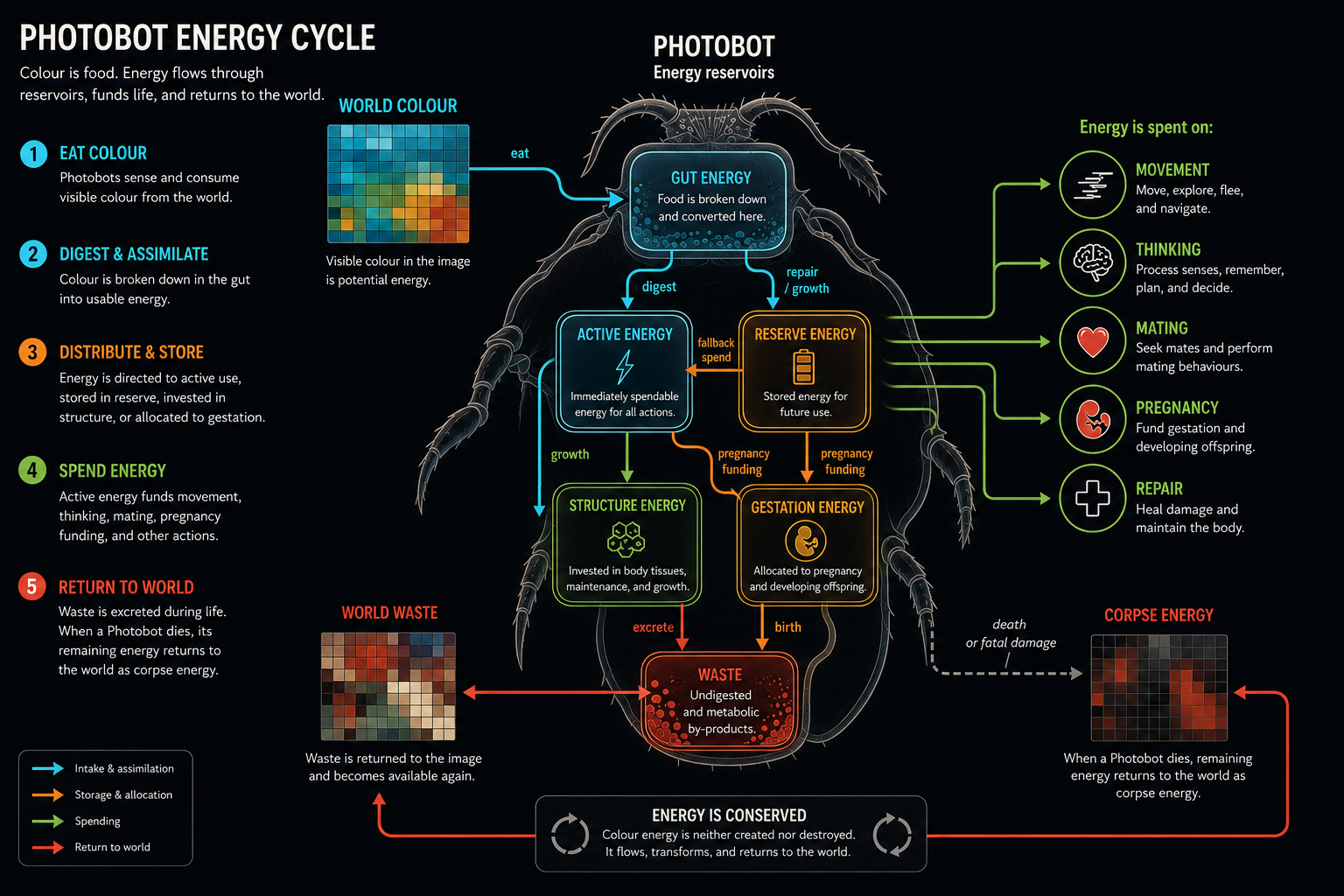
Energy is measured in phWatt. A bot does not simply have one generic battery.
Its internal energy is split across several reservoirs:
| Reservoir | Public meaning |
|---|---|
| Active energy | Immediate liquid energy for action |
| Reserve energy | Stored energy that can be released later |
| Gut energy | Recently eaten colour waiting to digest |
| Structure energy | Embodied tissue and body integrity |
| Gestation energy | Energy already committed to pregnancy |
| Waste | Unused or inefficient energy waiting to return to the world |
A bot usually cannot use freshly eaten colour as soon as it eats it. There is a digestive process. The bot must assimilate that energy into usable stores first.
#Bodies and Morphology
Photobots have a head, torso, and limbs. Size, reach, sensor range, speed, armour, metabolism, gestation cost, and structure all change what a bot can do and how much energy it uses to do it.
The same colour patch can mean different things to two bots. One might be close enough to eat it. Another might see it but lack the reach, energy, or attention state to act. This is why the project uses the word affordance: an opportunity formed by the relation between the world, the body, and the bot's current state. Different bots are genetically predisposed towards different colours.
#A Bot's Genome
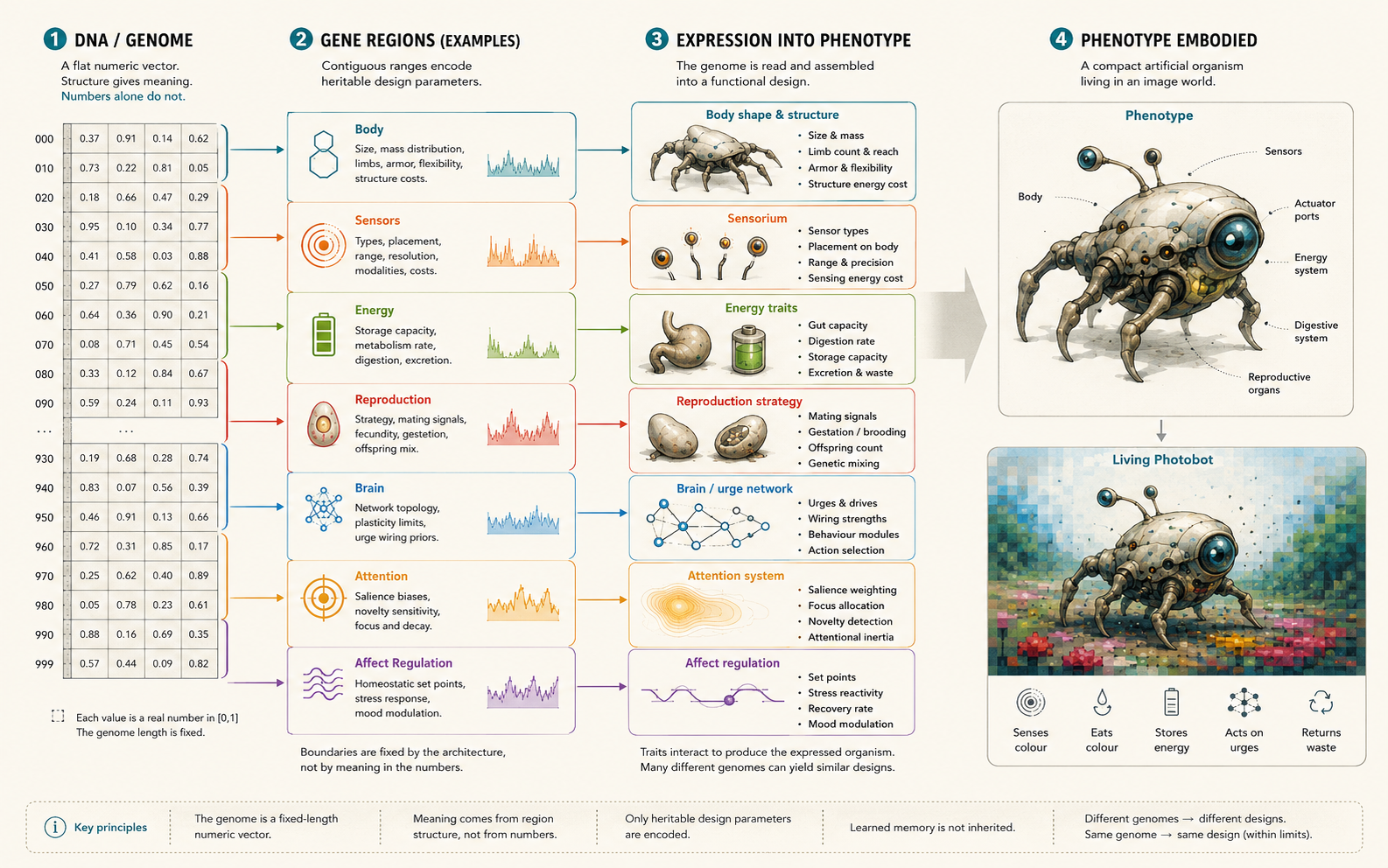
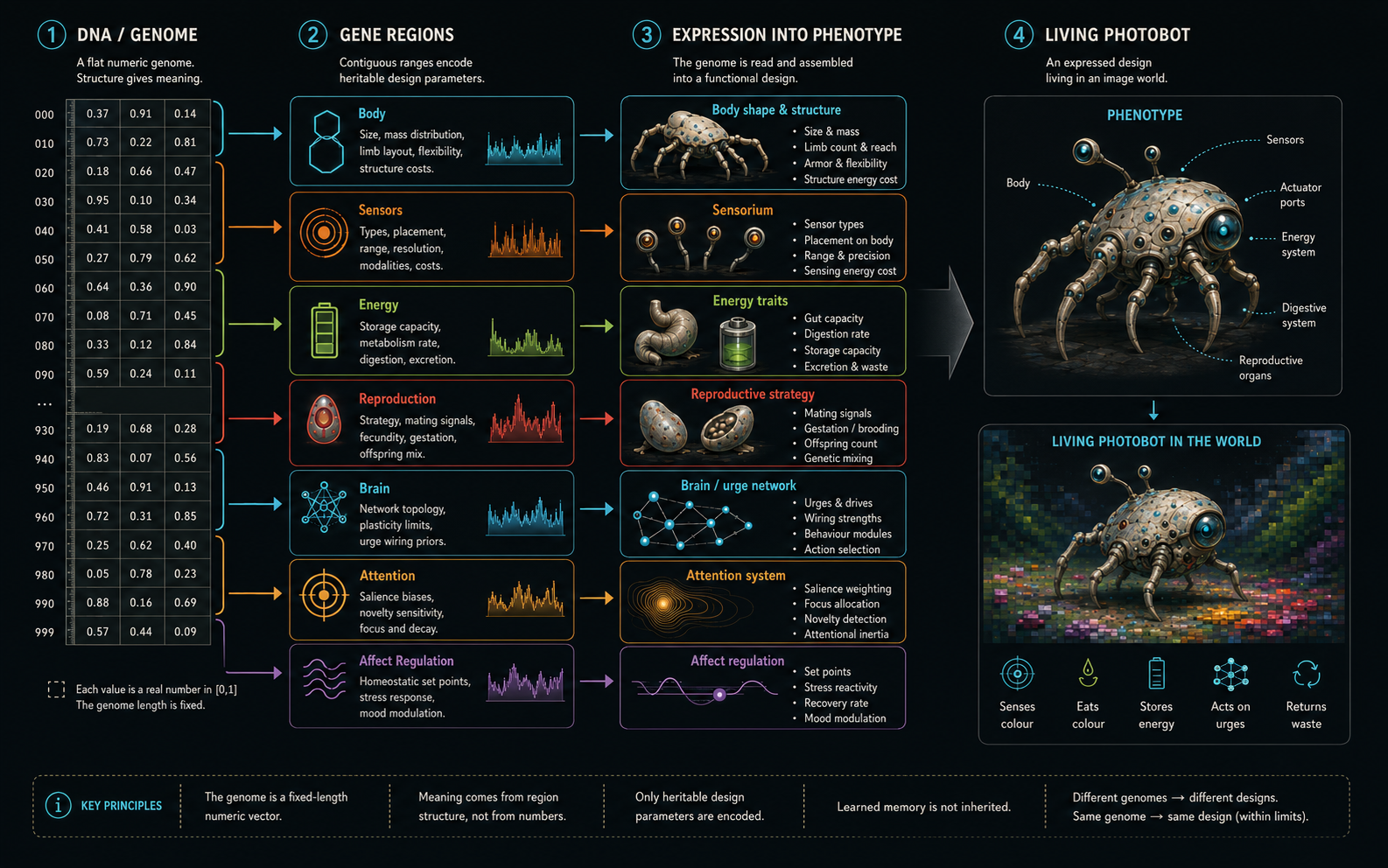
Photobot DNA is a numeric genome. It expresses body proportions, sensorium, energy traits, reproductive thresholds, urge-network shape, attention tendencies, and affect-regulation traits.
Founder bots begin the first run using fresh random genomes. During a run, living bots can reproduce sexually through crossover and mutation. After a run, selected genetic material can be saved as archetypes for future seeding.
Archetypes are breeding stock. Learned runtime memory and one bot's private history are not inherited as if they were genes.
#There Is No Driver
A Photobot does not have a hidden controller that “knows” the world. Signals from the world and body flow through sensors and sparse urge nodes. Attention selects a focus. Consequence traces can bias or veto urges. Intent emerges as a direction for action: move, eat, fight, mate, excrete, sleep, or conserve.
All these words are simply model terms. They make the mechanics easier to discuss.
#Maturation, Mating, Pregnancy, and Birth
A bot must mature before becoming capable of reproduction. Mating has an action cost. Pregnancy commits energy to gestation. Gestation can fall behind when energy is short, and combat damage can consume energy already committed to gestation, reducing funded embryo budgets and setting the pregnancy back. Birth transfers embryo energy into newborn bodies, along with a configurable amount of 'yolk': reserve energy for the new baby bot to feed on.
Reproduction competes with longevity. Energy spent on pregnancy is energy not used to grow, move, feed, or fight. Energy kept for movement or repair is energy not yet committed to the next biological generation.
Before bots can get pregnant, they need to learn to move, survive, seek out suitable mates, and more.
#Waste, Death, and Evolution
Spent energy returns to the world. Waste, overflow, failed biological work, damage, and corpses all leave material behind. The image records those transactions as visible change.
Photobots has two stages of evolution: one within the world the Photobots can perceive, and one external to that world. In-world bots meet other bots and have babies, which inherit the traits of their parents. If the world's population falls to the configured floor, that world is reset, and new bots are selected using a complex, adaptive fitness test.
#Iteration Versus Generation
biological generation is ancestry depth: founders are generation
0, their children are generation1, and so oniteration is run progress: one complete simulation pass from seeding or resume through its finish condition. Bots start in iteration
0, and the iteration ends when the population falls to the configured population floor
#Glossary
Photobot
: An artificial life form that lives in an image-derived world.
Founder bots
: The bots initially seeded into the world. Bots can be seeded as adults or
newborns.
World
: The simulation environment derived from an input image.
phWatt
: A “photo Watt”: the Photobots unit of energy.
Iteration
: One complete simulation pass inside a run.
Biological generation
: A bot ancestry depth, not run progress.
DNA / Genome
: Inherited numeric material that expresses body, brain, physiology,
reproduction, and behaviour traits.
Sensor
: A body part that samples local world or body signals, such as nearby colour,
light, damage, energy, or another bot.
Sense
: To read local signals through sensors and make them available to the bot's
urge network.
Urge
: A modelled drive that can shape attention and action.
Attention
: A modelled selection of focus in the bot's urge network.
Intent
: The action direction that emerges from sensors, urges, attention, consequence
traces, and available energy.
Eating
: An action that moves reachable colour energy from the world into the bot's
gut.
Digestion
: The assimilation step that converts gut energy into bot energy reservoirs
that can later support action, repair, growth, or reproduction.
Combat
: A costly interaction where bots fight. Damage consumes the defender's
energy and can harm its structure; during pregnancy it can also consume energy
committed to gestation and reduce funded embryo budgets.
Waste
: Energy that leaves useful bot reservoirs and returns to the world.